If you’ve ever typed “more then” and paused for a second, wondering if it’s correct you’re definitely not alone. This is one of the most common grammar mix-ups in English, and it trips up even confident writers.
The good news? Once you understand the difference between “more then” vs “more than,” it becomes incredibly easy to get right every time. In this guide, you’ll learn the correct usage, see clear examples, avoid common mistakes, and build confidence in your writing.
Quick Answer
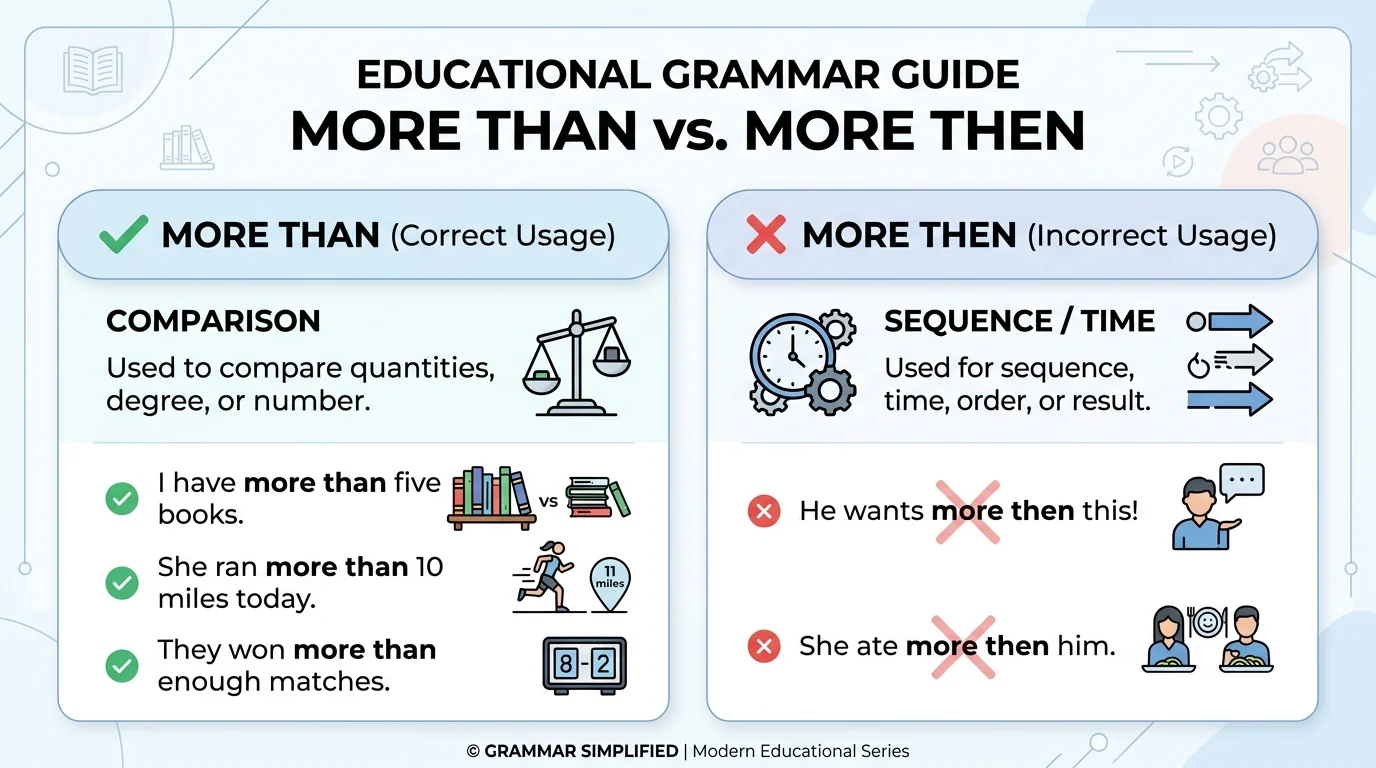
“More than” is correct in almost all cases.
“More then” is usually incorrect unless you’re using “then” to refer to time or sequence (which is rare in this phrase).
✔ Correct: I have more than enough time.
❌ Incorrect: I have more then enough time.
Understanding “More Than”
“More than” is a phrase used to compare quantities, amounts, or degrees. It simply means greater than.
When to Use “More Than”
Use “more than” when you’re talking about:
- Numbers or quantities
- Comparisons
- Emphasis or exaggeration
Examples of “More Than”
- She has more than 10 years of experience.
- I love you more than words can say.
- There were more than 100 people at the event.
- This is more than just a job it’s a passion.
Understanding “More Then”
“More then” is almost always incorrect in standard English.
The word “then” relates to time, sequence, or what happens next—not comparison.
When “Then” Is Correct (But Not in This Phrase)
“Then” works in sentences like:
- Finish your homework, then go outside.
- Back then, things were different.
- If this happens, then we’ll act.
But combining “more” with “then” rarely makes grammatical sense.
Rare Edge Case
Technically, “more then” could appear if “then” is used separately in a sentence structure, but this is extremely uncommon and usually awkward.
Example (rare and unnatural):
- He earned more, then invested it wisely.
Even here, it’s not functioning as a phrase.
More Then vs More Than: Key Differences
Here’s a simple breakdown to help you remember:
| Feature | More Than | More Then |
|---|---|---|
| Meaning | Greater in amount or degree | Refers to time/sequence |
| Correct usage | ✔ Yes | ❌ No (in most cases) |
| Common use | Comparisons | Time-related statements |
| Example | More than 50 people came | Incorrect usage |
Common Mistakes to Avoid
Even experienced writers make this mistake because “then” and “than” sound similar. Here are the most common errors:
1. Using “then” instead of “than”
❌ She is smarter then me.
✔ She is smarter than me.
2. Mixing up comparison and sequence
❌ I have more then enough food.
✔ I have more than enough food.
3. Typing errors (autocorrect issues)
Sometimes, autocorrect replaces “than” with “then.” Always double-check your writing—especially in emails or professional content.
Easy Trick to Remember the Difference
Here’s a simple memory hack:
- “Than” = comparison (think: greater THAN)
- “Then” = time (think: what happens THEN)
If your sentence compares something, you almost always need “than.”
American vs British English Differences
Good news—there’s no difference between American and British English when it comes to “more than vs more then.”
- Both forms follow the same grammar rules
- “More than” is correct in both
- “More then” is incorrect in both
So no matter where you’re writing from the US to the UK or anywhere else the rule stays the same.
Practice Examples
Let’s test your understanding:
Choose the correct option:
- I need more ___ enough time.
✔ Answer: than - Finish this task, ___ move to the next one.
✔ Answer: then - There are more ___ 20 students in class.
✔ Answer: than - Back ___, life was simpler.
✔ Answer: then
FAQs
1. Is “more then” ever correct?
Almost never. It’s usually a mistake. Use “more than” for comparisons.
2. Why do people confuse “then” and “than”?
They sound similar, especially in fast speech, which leads to spelling errors.
3. Can I use “more than” for emphasis?
Yes! It’s often used to emphasize feelings or ideas.
Example: This means more than everything to me.
4. Is “more than enough” correct?
Yes, it’s a very common and correct phrase.
5. What part of speech is “than”?
“Than” is a conjunction used in comparisons.
6. What part of speech is “then”?
“Then” is usually an adverb related to time or sequence.
7. How can I avoid this mistake in writing?
Proofread carefully and remember: comparison = “than,” time = “then.”
8. Is this mistake common in professional writing?
Yes, but it should be avoided. It can reduce credibility in formal or SEO content.
Summary
The difference between “more then vs more than” is simple but important. “More than” is the correct phrase used for comparisons, quantities, and emphasis, while “more then” is almost always a grammatical mistake. Understanding this distinction can instantly improve the clarity and professionalism of your writing.
By remembering that “than” is for comparison and “then” is for time, you can avoid one of the most common English errors. Whether you’re writing emails, blog posts, or social media content, using the correct form helps you communicate more effectively and confidently.
Actionable Takeaway
Next time you write a sentence with “more,” pause for a second and ask:
👉 Am I comparing something? If yes, use “more than.”
Make it a habit to proofread your writing, especially for commonly confused words. Small improvements like this can make a big difference in how polished and professional your English appears.