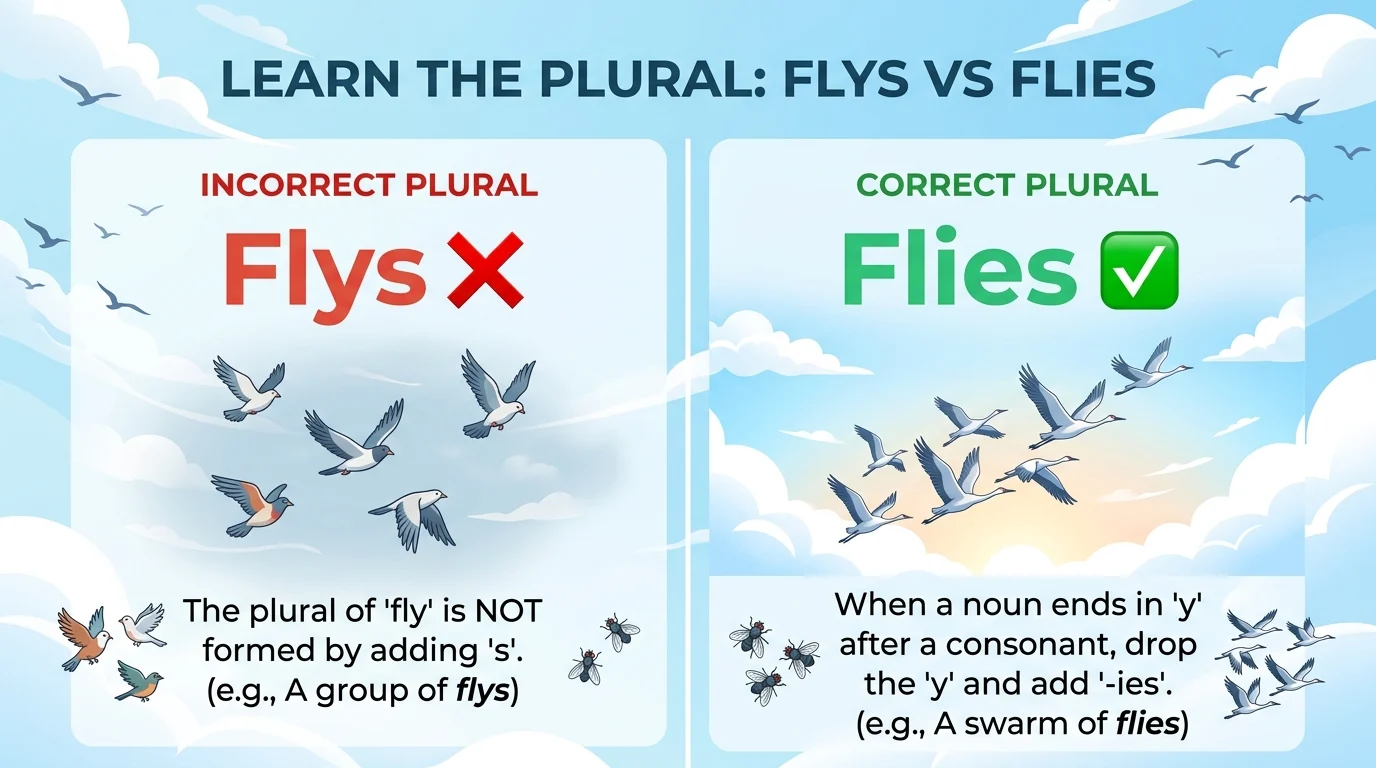
Have you ever written “flys” and stopped to think if it’s right? This is a very common confusion in English especially because both versions look possible. But only one is correct in most situations.
In this guide, we’ll clearly explain flys vs flies, show the correct usage, provide examples, and help you avoid this mistake with confidence.
Quick Answer
- ✅ Flies is the correct spelling (for plural and verb form)
- ❌ Flys is incorrect in standard English
Always use flies when talking about more than one fly or when using the verb “fly” in third-person singular.
What Does “Flies” Mean?
Flies has two main uses:
1. Plural of “fly” (the insect)
- One fly → Two flies
2. Verb form (he/she/it flies)
- Used when describing someone or something that is flying
Example sentences:
- There are many flies in the room.
- The bird flies over the trees.
- Time flies when you’re having fun.
Why “Flys” Is Incorrect
The spelling “flys” breaks a common English grammar rule.
The rule:
When a word ends in a consonant + “y”, you:
👉 Change the “y” to “ies” when making it plural or forming certain verb forms.
So:
- fly → flies ✅
- fly → flys ❌
Similar examples:
- baby → babies
- city → cities
- story → stories
Flys vs Flies: Key Differences
| Feature | Flies | Flys |
|---|---|---|
| Correct | ✔ Yes | ✖ No |
| Grammar rule | Follows “y → ies” rule | Breaks rule |
| Usage | Standard English | Misspelling |
| Recommended | Always use | Avoid completely |
Common Mistakes to Avoid
1. Adding just “s” instead of “ies”
- ❌ The bird flys away
- ✔ The bird flies away
2. Forgetting the “y → ies” rule
This rule applies to many common words.
3. Typing too quickly
“Flys” often appears as a simple typo double-check your spelling.
Helpful Tip to Remember
Think of it like this:
👉 If a word ends in “y” after a consonant, change it to “ies”
So:
👉 fly → flies
More Examples of “Flies” in Context
- The airplane flies at a high altitude.
- These flies are annoying.
- She flies to work every week.
- The kite flies in the sky.
Synonyms and Related Words
Depending on context, you can also use:
- Soars
- Glides
- Travels (for movement)
- Insects (for flies as bugs)
These help add variety to your writing.
American vs British English
There’s no difference here:
- Flies is correct in both American and British English
- Flys is incorrect in both
FAQs About Flys vs Flies
1. Is “flys” ever correct?
No, flys is not correct in standard English.
2. Why do people write “flys”?
Because they forget the “y → ies” spelling rule.
3. What is the plural of “fly”?
The plural is flies.
4. What does “flies” mean as a verb?
It means moving through the air (e.g., “He flies a plane”).
5. Is “flies” used in formal writing?
Yes, it is correct and widely used in all contexts.
6. Are there exceptions to the “y → ies” rule?
Yes—if a vowel comes before “y,” just add “s” (e.g., boy → boys).
7. How can I remember this rule?
Think: consonant + y = ies
Summary
When comparing flys vs flies, the correct spelling is always flies. It follows a simple and important English rule: when a word ends in a consonant + “y,” you change the “y” to “ies.” The version flys is a common mistake and should be avoided in all writing.
Understanding this pattern not only helps with this word but also improves your spelling for many others. Once you learn it, you’ll use it naturally.
Actionable Takeaway
Next time you write the word, remember:
👉 Fly → flies (change “y” to “ies”)
This one simple rule will help you avoid many spelling mistakes.