If you’ve ever paused between “transferring” and “transfering,” you’re not alone. Double letter spelling rules in English can be confusing but this one follows a clear pattern.
Let’s break it down simply so you always get it right.
Quick Answer
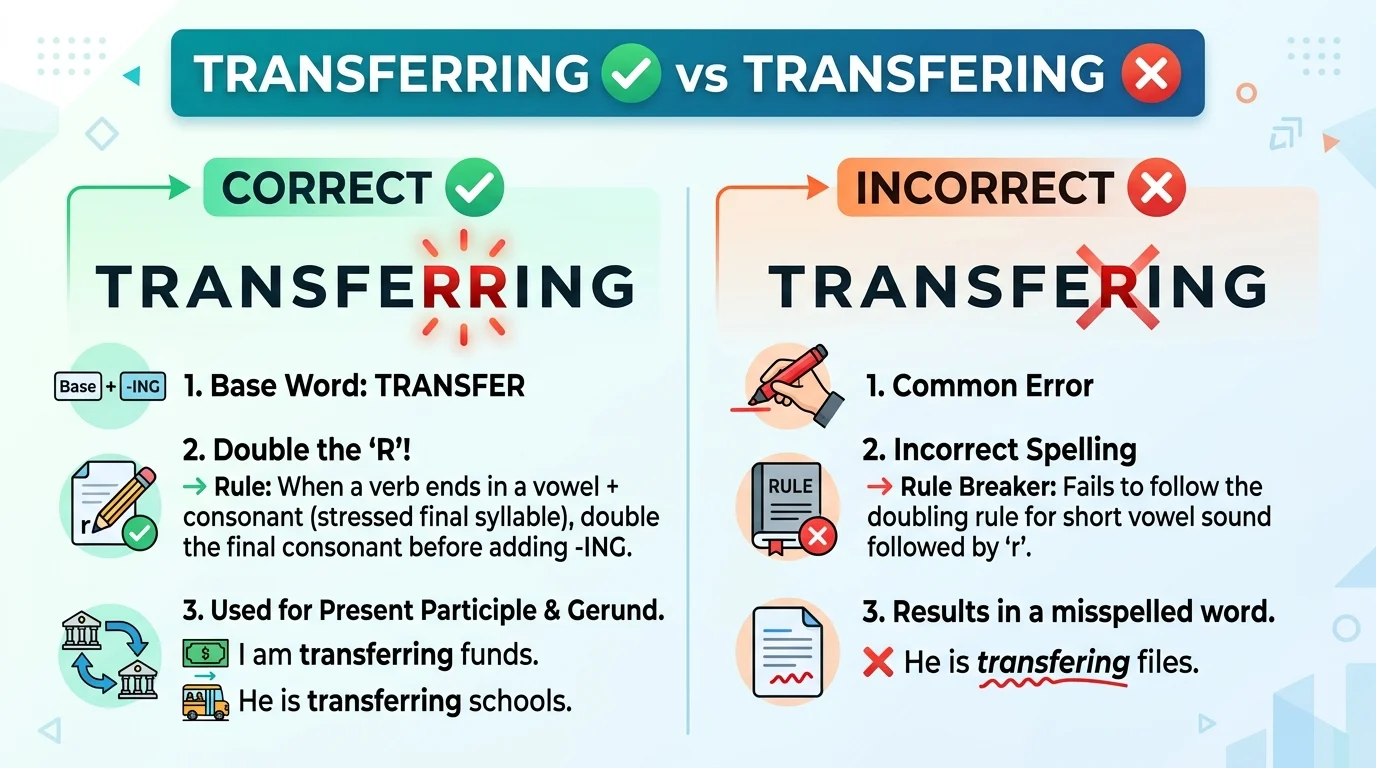
“Transferring” is correct.
“Transfering” is incorrect and should not be used.
✔ Correct: She is transferring the files.
❌ Incorrect: She is transfering the files.
What Does “Transferring” Mean?
“Transferring” is the -ing form of “transfer.” It means:
- Moving something from one place to another
- Passing responsibility or ownership
- Changing from one system, account, or location to another
Examples of “Transferring”
- He is transferring money to another account.
- She is transferring schools next year.
- They are transferring data to a new server.
- The patient is transferring to another hospital.
Why Is It “Transferring” (Double “r”)?
Here’s the key rule:
👉 You double the final consonant when:
- The word ends in vowel + consonant
- The final syllable is stressed
Apply the rule to “transfer”
- “Transfer” ends with -fer
- The stress is on the last syllable: trans-FER
Because the stress is at the end, you double the “r” before adding “-ing”
So:
- Transfer → Transferring ✔
- Not → Transfering ❌
Transferring vs Transfering: Comparison Table
| Feature | Transfering | Transferring |
|---|---|---|
| Correct spelling | ❌ No | ✔ Yes |
| Rule followed | No | Yes |
| Usage | Misspelling | Standard English |
| Example | Transfering funds ❌ | Transferring funds ✔ |
Common Mistakes to Avoid
1. Forgetting to double the “r”
❌ They are transfering files.
✔ They are transferring files.
2. Confusing with similar verbs
Compare:
- Refer → Referring ✔
- Prefer → Preferring ✔
- Transfer → Transferring ✔
3. Ignoring stress rules
The position of stress determines if you double the consonant.
Easy Trick to Remember
Think of it like this:
👉 “transFER” sounds strong at the end → add an extra “r”
Strong ending = double consonant
American vs British English
Here’s a small note:
- Both American and British English use “transferring”
- The rule and spelling are the same in both
Practice Questions
Choose the correct form:
- She is ___ money online.
✔ transferring - They are ___ data to a new system.
✔ transferring - He is ___ to another department.
✔ transferring
FAQs
1. Is “transfering” ever correct?
No, it’s always a spelling mistake.
2. Why does “transferring” have double “r”?
Because the final syllable is stressed, so the consonant is doubled.
3. What is the base word of “transferring”?
The base word is “transfer.”
4. Are there similar words with double letters?
Yes, like “referring” and “preferring.”
5. Is “transferring” used in formal writing?
Yes, it’s a standard and correct form.
6. How can I remember the correct spelling?
Think: transFER → transferring (double “r”)
Summary
The difference between “transferring vs transfering” is simple: “transferring” is correct, while “transfering” is a common misspelling. The correct form follows the rule of doubling the final consonant when the stress is on the last syllable.
Understanding this rule helps you avoid similar mistakes and improves your overall writing accuracy.
Actionable Takeaway
Next time you write the word, remember:
👉 Always use transferring, never transfering
Take a moment to check spelling small details like this make your writing more polished and professional.