If you’ve ever typed “havnt” or “havent” and wondered which one is right, you’re not alone. These forms show up often in quick typing, texts, and even informal writing but only one version is actually correct in standard English.
Let’s clear up the confusion so you can write it properly every time.
Quick Answer
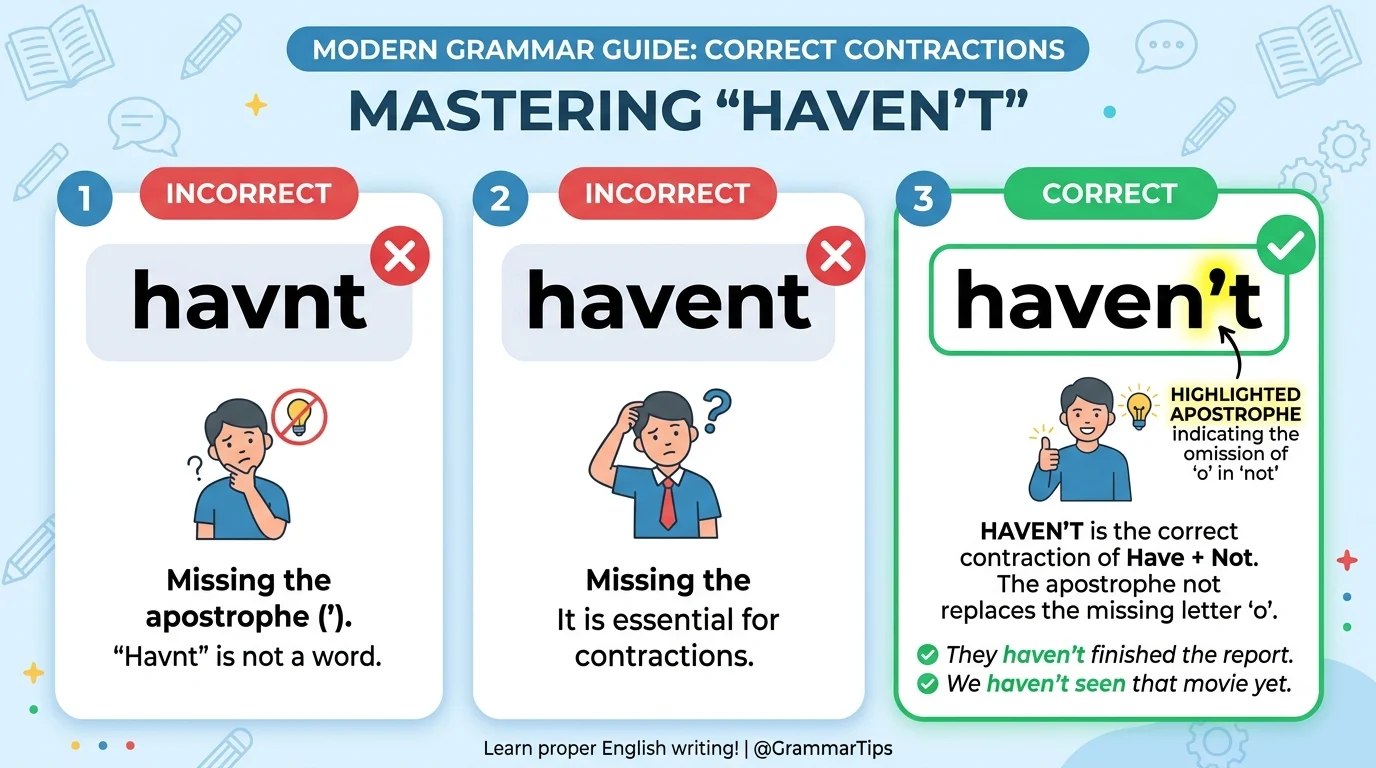
Neither “havnt” nor “havent” is correct.
The correct form is: “haven’t” (with an apostrophe)
✔ Correct: I haven’t finished my work.
❌ Incorrect: I havent finished my work.
❌ Incorrect: I havnt finished my work.
What Does “Haven’t” Mean?
“Haven’t” is a contraction of:
👉 have not
It’s commonly used in everyday English to show that something has not happened or is not true.
Examples of “Haven’t”
- I haven’t seen that movie yet.
- They haven’t arrived yet.
- We haven’t made a decision.
- She hasn’t called me back. (related form)
Why “Havent” Is Incorrect
“Havent” is missing the apostrophe (’), which is essential in contractions.
In English:
- Apostrophes show that letters are missing
- “Have not” → haven’t (the “o” is removed)
Without the apostrophe, the word is considered incorrect in formal writing.
Why “Havnt” Is Also Incorrect
“Havnt” is even further from the correct form because:
- It removes both the vowel and the apostrophe
- It doesn’t follow any standard English rule
It’s often just a typing shortcut or mistake, especially in casual texting.
Havnt vs Havent vs Haven’t: Comparison Table
| Form | Correct? | Meaning | Usage |
|---|---|---|---|
| Havnt | ❌ No | None | Informal typo |
| Havent | ❌ No | None | Missing apostrophe |
| Haven’t | ✔ Yes | “Have not” | Standard English |
Common Mistakes to Avoid
1. Skipping the apostrophe
❌ I havent done it yet.
✔ I haven’t done it yet.
2. Shortening too much
❌ I havnt seen it.
✔ I haven’t seen it.
3. Using informal text in formal writing
While “havnt” might appear in chats, it should never be used in emails, articles, or professional content.
Easy Trick to Remember
Think of it this way:
👉 If you can expand it to “have not,” you need an apostrophe
Have not → Haven’t
No apostrophe = incorrect.
American vs British English
There’s no difference here:
- Both American and British English use “haven’t”
- “Havent” and “havnt” are incorrect everywhere
Practice Questions
Choose the correct form:
- I ___ finished my homework.
✔ haven’t - They ___ responded yet.
✔ haven’t - We ___ seen this before.
✔ haven’t
FAQs
1. Is “havent” ever correct?
No, it’s incorrect because it lacks the apostrophe.
2. Is “havnt” acceptable in texting?
It may appear in casual texting, but it’s not correct English and should be avoided.
3. What is the correct form of “have not”?
The correct contraction is “haven’t.”
4. Why is the apostrophe important?
It shows that letters are missing in a contraction.
5. Can I use “haven’t” in formal writing?
Yes, it’s widely accepted in both formal and informal contexts.
6. What are similar contractions?
- Don’t (do not)
- Can’t (cannot)
- Won’t (will not)
Summary
The difference between “havnt vs havent” is simple: both are incorrect. The only correct form is “haven’t,” which is the proper contraction of “have not.” The apostrophe plays a key role and should never be skipped.
Using the correct form improves your grammar, clarity, and professionalism—especially in formal writing or SEO content.
Actionable Takeaway
Next time you write:
👉 Always use “haven’t”
👉 Never use “havent” or “havnt”
Take a second to check for apostrophes this small detail makes a big difference in your writing quality.