If you’ve ever paused while typing “occurring” or “occuring,” you’re not alone. This is a very common spelling confusion even for fluent English writers because of the tricky double letters.
Let’s clear it up so you can write it correctly every time.
Quick Answer
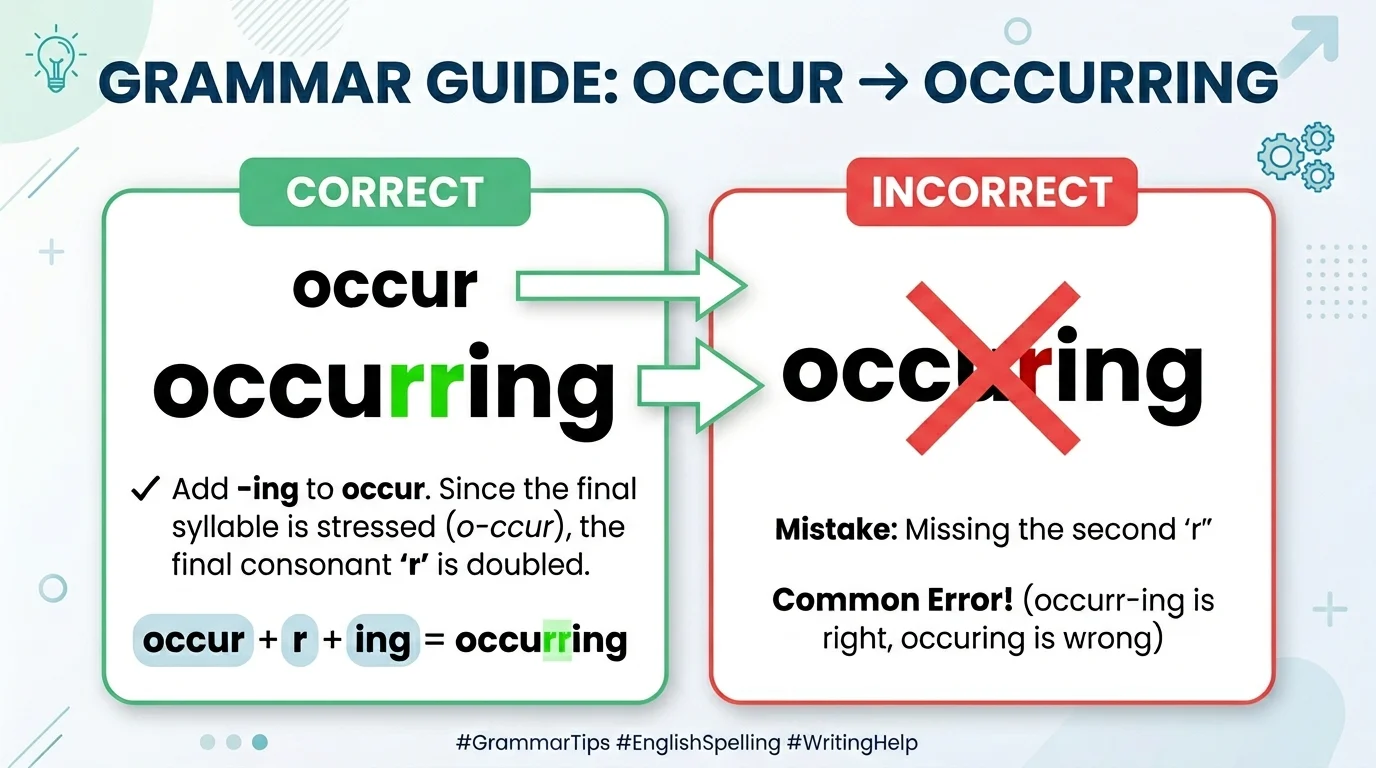
“Occurring” is the correct spelling.
“Occuring” is incorrect and should not be used.
✔ Correct: The issue is occurring frequently.
❌ Incorrect: The issue is occuring frequently.
What Does “Occurring” Mean?
“Occurring” is the present participle (or -ing form) of the verb “occur.” It means:
- Happening
- Taking place
- Coming into existence
Examples of “Occurring”
- The problem is occurring more often than before.
- A meeting is occurring right now.
- Changes are occurring rapidly in technology.
- The event is occurring next week.
Why Is It “Occurring” (Double “r”)?
This is where most people get confused.
The verb “occur” ends with a stressed syllable and a consonant (r). When adding “-ing,” you double the final consonant before adding the suffix.
Rule:
👉 If a verb ends in:
- vowel + consonant
- and the last syllable is stressed
➡ You double the consonant before adding “-ing”
So:
- Occur → Occurring ✔
- Refer → Referring ✔
- Begin → Beginning ✔
Why “Occuring” Is Wrong
“Occuring” drops one “r,” which breaks the spelling rule. It’s a common typo caused by:
- Forgetting the doubling rule
- Typing quickly
- Mispronunciation
Using “occuring” in formal writing can reduce credibility and readability.
Occurring vs Occuring: Comparison Table
| Feature | Occurring | Occuring |
|---|---|---|
| Correct spelling | ✔ Yes | ❌ No |
| Grammar rule | Follows consonant doubling | Breaks rule |
| Usage | Standard English | Misspelling |
| Example | It is occurring now | Incorrect form |
Common Mistakes to Avoid
1. Dropping one “r”
❌ This is occuring too often.
✔ This is occurring too often.
2. Confusing with similar words
Words like “opening” don’t double the consonant, which can confuse learners:
- Open → Opening ✔ (no doubling)
- Occur → Occurring ✔ (doubling needed)
3. Relying on spellcheck
Some tools might miss the error always proofread carefully.
Easy Trick to Remember
Think of it this way:
👉 “Occur” needs extra emphasis, so it gets an extra “r”
Occur → Occurring (double r)
American vs British English
Good news there’s no difference here:
- Both American and British English use “occurring”
- “Occuring” is incorrect in both
Practice Questions
Choose the correct spelling:
- The issue is ___ again.
✔ occurring - A strange event is ___ tonight.
✔ occurring - This keeps ___ repeatedly.
✔ occurring
FAQs
1. Is “occuring” ever correct?
No, it’s always a spelling mistake.
2. Why does “occurring” have double “r”?
Because of the consonant doubling rule when adding “-ing.”
3. Is “occurred” also double “r”?
Yes!
✔ Occurred (correct)
❌ Occured (incorrect)
4. How do I remember the correct spelling?
Think: “Occur needs two R’s when it grows.”
5. Does pronunciation affect spelling here?
Not always English spelling rules matter more than sound.
6. Is this mistake common?
Yes, even advanced writers sometimes make it.
Summary
The difference between “occurring vs occuring” is simple: “occurring” is correct, while “occuring” is a common misspelling. The correct form follows the rule of doubling the final consonant when adding “-ing” to a stressed verb like “occur.”
Understanding this rule helps you avoid similar mistakes and improves your overall writing accuracy. Small spelling details like this make a big difference in how professional your writing appears.
Actionable Takeaway
Next time you write “occur,” remember:
👉 Add -ing and double the “r” → occurring
Take a second to proofread your writing catching small errors builds stronger, more confident English skills.