Have you ever typed “puting” and paused, wondering if it looks right? You’re not alone. This tiny spelling difference can trip up even confident writers especially in fast typing or casual messages.
In this quick, clear guide, we’ll break down puting vs putting, explain the correct spelling, show real examples, and help you avoid this common mistake for good.
Quick Answer
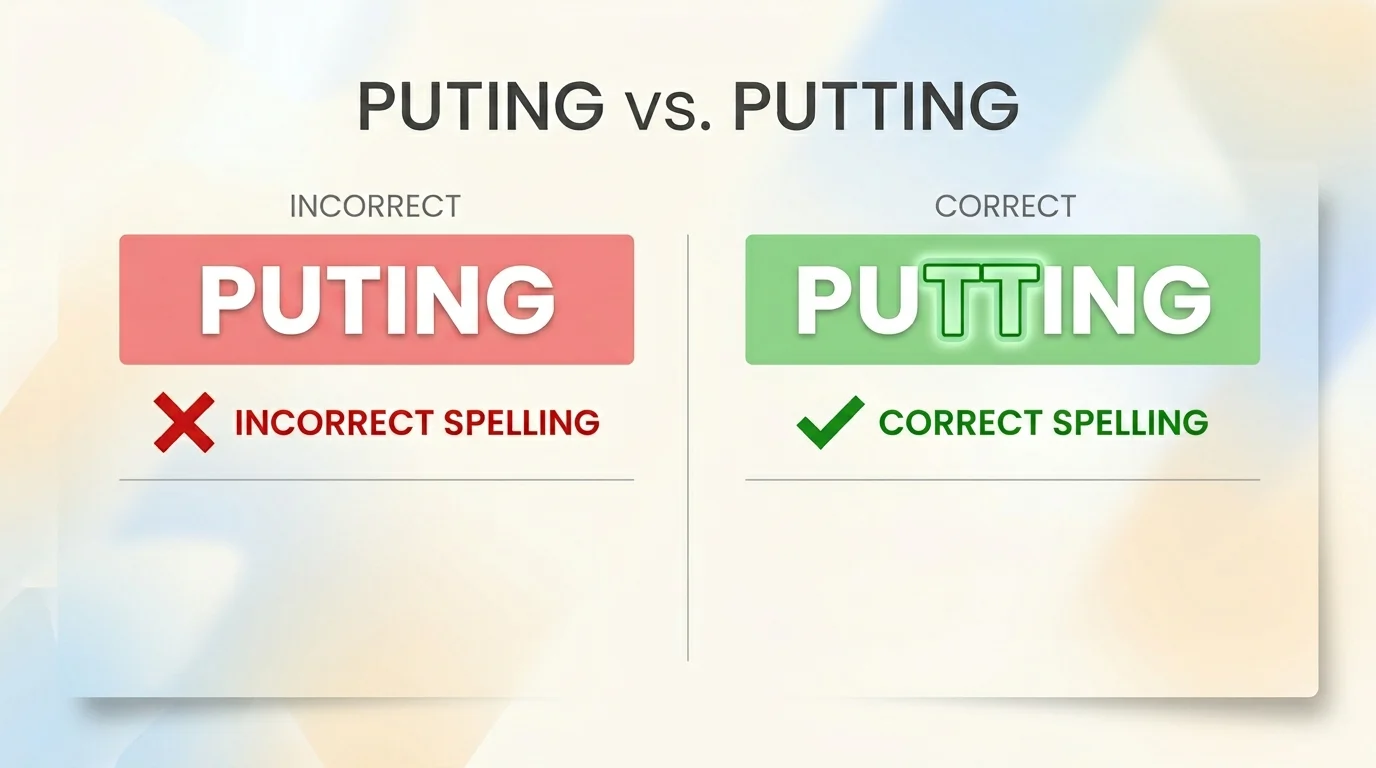
- ✅ Putting is the correct spelling
- ❌ Puting is incorrect and considered a spelling mistake
Always use putting in both formal and informal writing.
What Does “Putting” Mean?
Putting is the present participle (–ing form) of the verb “put.” It means placing or moving something into a particular position.
Common meanings:
- Placing something somewhere
- Assigning or expressing something
- In sports (like golf), gently hitting a ball
Example sentences:
- She is putting the books on the shelf.
- He’s putting a lot of effort into his work.
- They are putting together a new project.
Why “Puting” Is Incorrect
The spelling “puting” breaks a key English grammar rule.
The Rule:
When a verb ends in a single vowel + consonant, you usually double the final consonant before adding -ing.
So:
- put → putting ✅
- run → running
- sit → sitting
Without doubling the “t,” the word becomes incorrect—hence, puting is not accepted in standard English.
Puting vs Putting: Key Differences
| Feature | Putting | Puting |
|---|---|---|
| Correct | ✔ Yes | ✖ No |
| Grammar rule | Follows doubling rule | Breaks rule |
| Usage | Standard English | Typo/misspelling |
| Recommended | Always use | Avoid completely |
Common Mistakes to Avoid
1. Dropping the extra “t”
- ❌ I am puting my phone away
- ✔ I am putting my phone away
2. Typing too fast
“Puting” often appears due to typing quickly—always proofread short words carefully.
3. Assuming short words don’t follow rules
Even simple verbs like “put” follow spelling patterns when adding -ing.
Helpful Tip to Remember
Think of it like this:
👉 “Put” is short, so it needs extra strength (another ‘t’) before adding -ing → putting
More Examples of “Putting” in Context
- She kept putting off her homework.
- We are putting the plan into action.
- He’s putting his trust in you.
- They are putting money aside for the future.
FAQs About Puting vs Putting
1. Is “puting” ever correct?
No, puting is always incorrect in standard English.
2. Why is “putting” spelled with two t’s?
Because of the consonant doubling rule when adding -ing to short verbs.
3. Does this rule apply to other words?
Yes! Examples include:
- run → running
- swim → swimming
- sit → sitting
4. Is “putting” used in American and British English?
Yes, putting is correct in both there’s no difference here.
5. What does “putting” mean in golf?
In golf, putting refers to gently hitting the ball toward the hole on the green.
6. How can I avoid spelling mistakes like this?
Slow down when typing and remember common patterns like consonant doubling.
Summary
When it comes to puting vs putting, the correct spelling is always putting. It follows a basic English rule where the final consonant is doubled before adding -ing. On the other hand, puting is simply a common typo and should be avoided in all forms of writing.
Mastering small details like this can make your writing clearer, more professional, and easier to read. Even simple words follow important patterns and learning them helps you write with confidence.
Actionable Takeaway
Next time you write the word, pause for a second and remember:
👉 Double the “t” → putting
This one small habit will instantly improve your spelling accuracy.